

Regional Institute Faculty Member and Former IFME Fellow Payal Bansal Enters FAIMER Institute
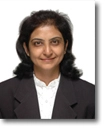
Payal Bansal, M.B.B.S., M.S. (Surgery), P.G. Dip (Health Education)
Associate Professor, Department of Medical Education
Maharashtra University of Health Sciences
Pune Regional Center
Pune, INDIA
For most incoming Fellows, the FAIMER Institute marks the beginning of what will hopefully be a long and productive association with the Foundation. But for one member of the 2007 FAIMER Institute class, the Fellowship is just one more facet of an already established collaboration with the organization.
Payal Bansal, M.B.B.S., M.S. (Surgery), P.G. Dip (Health Education), of Pune, India, has been involved with FAIMER since 2004 when she was awarded a Fellowship through FAIMER’s International Fellowship in Medical Education (IFME) program. As part of her IFME Fellowship, Payal spent one year studying in residence at the University of Michigan Medical School, Ann Arbor, Department of Medical Education. Through her Fellowship, she wanted to equip herself with a wide array of educational tools to enable her to initiate meaningful and need-based educational reform that would help to meet the challenges facing medical education in India. Her Fellowship allowed her to participate in a variety of teaching and learning activities, including courses taught by Medical Education Department faculty as well we the school’s Medical Education Scholar’s Program and Standardized Patient Program. She also learned to construct standardized assessments, which allowed her to successfully implement an assessment for new entrants into a post graduate surgical program when she returned to India in May 2005.
In February 2007, a paper based on this project, “From a ‘Generalist’ Medical Graduate to a ‘Specialty’ Resident: Can an Entry-level Assessment Facilitate the Transition? Assessing the Preparedness Level of New Surgical Trainees,” which she co-authored with 2003 FAIMER Institute Fellow Vivek A. Saoji, M.B.B.S., M.S. (Surgery), and her IFME mentor Larry D. Gruppen, Ph.D., won the Best Oral Presentation (Merit) Award at the 4th Asia-Pacific Medical Education Conference. The paper was subsequently published in the Annals, Academy of Medicine, Singapore (Ann Acad Med Singapore 2007;36:719-24).
Payal also has had the opportunity to pursue the goals that drew her to the IFME program in the first place, namely identifying ways to improve medical education in India. In October, a paper she co-authored with 2002 FAIMER Institute Fellow Avinash Supe, M.B.B.S., M.S., “Training of medical teachers in India: Need for change,” was published in the Indian Journal of Medical Sciences. She also has been heavily involved with FAIMER’s Regional Institutes over the last two years, currently serving as a faculty member for the GSMC-FAIMER, CMCL-FAIMER, and PSG-FAIMER Regional Institutes. Through the Regional Institutes she leads discussions on assessment, group dynamics, and project planning, and facilitates assessment discussions on FAIMER Fellow listservs.
Payal’s involvement with FAIMER continued in October 2007 when she became a member of the 2007 FAIMER Institute class, a fellowship she sees as an opportunity to cultivate some very important skills. “I feel that the Institute is a great learning experience,” explains Payal. “I spent a year learning about medical education but felt I still needed to improve my skills in group work and some aspects of leadership.” For Payal, who has spent so much time teaching teachers herself, participating in the FAIMER Institute has an added benefit: The chance to observe the process in action and gain a better understanding of how sessions are conducted at the FAIMER Institute—learning that will inform her work with the Regional Institutes.
Payal also feels that her FAIMER experiences will aid her as she undertakes her newest endeavor: an associate professorship in the Department of Medical Education at the Maharashtra University of Health Sciences, a university that has a number of health professions schools under its umbrella and is affiliated with Seth G.S. Medical College, host to the GSMC-FAIMER Regional Institute.
According to Payal, she was attracted to this new position because it offers her the opportunity to be involved in the shaping of a young department—it was just eight months old when she joined its ranks in December 2007—and the opportunity to make a difference within India’s health care system. “My interest in medical education has increased so much I would like to give it as much of my attention as possible,” she states.
Looking forward, Payal is excited about the opportunity to share what she has learned at the Institutes with the faculty in her new department, and to implement her education innovation project, “Establishment of priorities and strategic direction for a new department of medical education at a health science university using a 360 degree stakeholder assessment.”
For Payal, the FAIMER experience is more than just a highlight on her impressive CV. “The first time I saw the FAIMER concept map, it aligned so closely with what I want to see in my country—it’s like having an ally who shares your vision,” she says. “And as I worked with FAIMER, I became part of the process contributing to that change. I use a lot of what I have learned and continue to collaborate to move toward that shared vision.”